A parliamentary standing committee has requested detailed information regarding electricity generated by rooftop solar systems and fed into the national grid. The panel questioned the government's progress in achieving its target to add 4,000 MW of rooftop solar power by February of next year.
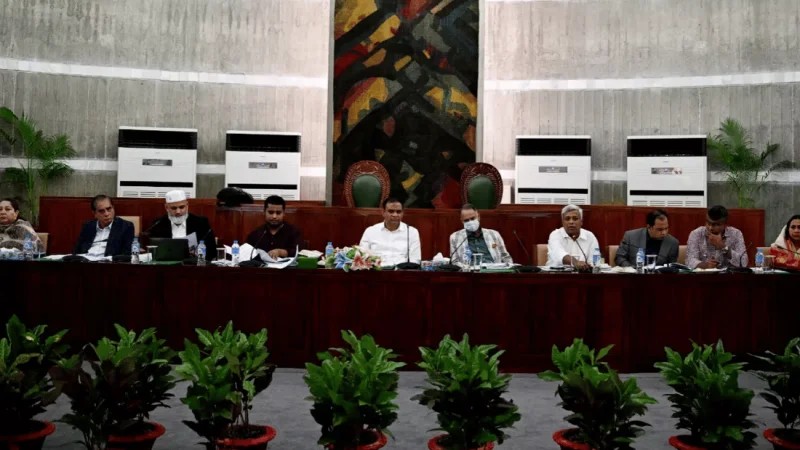
The Parliamentary Standing Committee on the Ministry of Power, Energy and Mineral Resources made the recommendation during its first meeting at the National Parliament on Saturday. The committee asked the ministry to provide a detailed account of monthly progress, project costs, and the imports of solar panels and inverters at its upcoming meeting.
Speaking to journalists after the meeting, committee member Hasnat Abdullah stated that the ministry’s data revealed that only 60MW of rooftop solar power had been added to the grid over the preceding 30 days, falling short of the 4,000MW target.
At this rate, only 720MW would be added by February, he said, adding that the committee had sought details of the monthly progress and letters of credit opened for importing solar panels and inverters.
The committee also questioned the cost of rooftop solar projects. Hasnat stated that a 50MW project should cost approximately Tk 150 crore, whereas the ministry had estimated the cost for a project of that capacity at over Tk 350 crore. Consequently, the committee asked the ministry to provide a detailed breakdown of the costs for individual projects.
According to the parliamentary secretariat, the meeting was informed that the Power Division had 41 ongoing development projects under the Annual Development Program for the 2026-27 fiscal year.
The projects have allocations of Tk 10,653 crore in project assistance, Tk 4,071.39 crore from government funds and Tk 3,381.80 crore from agencies’ own resources.
The meeting was also informed that the country's gas-fired power generation capacity stood at 12,022 MW, while actual generation ranged between 4,000 MW and 5,000 MW.
Coal-fired generation capacity stood at 6,927MW, with actual output fluctuating between 5,000MW and 6,000MW. Meanwhile, liquid-fuel-based plants possessed a capacity of 6,409MW while generating from 2,500MW to 3,000MW.
The committee was informed that consumers who install rooftop solar systems by February 28, 2027, will receive Tk 10.50 per unit for surplus electricity supplied to the national grid until February 28, 2030.
Committee member and Jamaat-e-Islami MP Nazibur Rahman stated that the ministry had acknowledged mismanagement, corruption, and a lack of planning behind the country's power and energy crisis during its presentation.
However, he stated that the ministry had failed to provide updates regarding the implementation of recommendations issued by a previous inquiry committee concerning capacity payments.
He said that a committee led by a judge had been formed following a High Court verdict concerning capacity charges. The parliamentary committee wanted to know what recommendations the inquiry body had made and what steps had been taken to implement them.
Nazibur also questioned the absence of regulations governing public hearings for energy price determination by the Bangladesh Energy Regulatory Commission (BERC).
He said Section 34 of the 2003 law provided for price determination through public hearings and the formulation of relevant regulations, but the process had not been implemented in 23 years.
The committee also sought clarification regarding whether public hearings had been conducted prior to the establishment of liquefied petroleum gas (LPG) prices as well as the recent increase in fuel prices.
Nazibur stated that global energy market disruptions were being compounded by domestic mismanagement and poor planning. He called for accountability regarding high-priced spot-market fuel purchases and urged the government to prevent businesses from exploiting the crisis.
He also demanded a clear timetable for drilling planned gas wells, expanding domestic exploration and accelerating offshore gas exploration.
Meanwhile, Hasnat Abdullah called for a forensic audit of the Tk 2.89 lakh crore paid in capacity charges within the power sector.
He stated that while the country possessed an electricity generation capacity of 29,000MW, actual generation hovered around 14,125MW. Furthermore, he noted that payments made under the Speedy Supply of Power and Energy (Special Provisions) Act 2010 should be subjected to a forensic audit.
Capacity payments, subsidies and overhauling charges beyond actual requirements were placing pressure on the economy, Hasnat added.
He also raised concerns over diesel stocks, stating they were sufficient for only 31 days. Noting that rural agriculture, transport, and economic activities depend heavily on diesel, he said the committee had sought a plan to increase reserves and prevent supply disruptions.
On LPG prices, Hasnat alleged that weak government monitoring had allowed market prices to rise far above the official rate.
Although the government-set price was around Tk 1,800 per cylinder, consumers were paying Tk 2,500 to Tk 2,600, he said.
The committee also sought an explanation for plans to establish new LNG and coal-fired power plants in Maheshkhali and Payra, saying such projects could undermine efforts to reduce dependence on imported energy.
It asked the ministry to provide projections for power generation capacity and peak demand in 2030, the expected shares of gas, coal, solar and nuclear power, and a timeline for shutting down idle oil-fired plants.
The committee also sought clarification on reports that 32 gas wells had been drilled within a short period, asking the ministry to distinguish between exploration and development wells.
Hasnat further raised concerns over excessive and allegedly fictitious electricity bills, saying some consumers had received bills ranging from Tk 3 crore to Tk 7 crore.
Nazibur said the ministry’s officials had not arrived at the first meeting with adequate information and preparation. He said committee members would submit their questions in advance to enable officials to provide detailed answers at the next meeting.
The meeting was chaired by committee chairman Mia Nuruddin Ahmed Apu and attended by Power, Energy and Mineral Resources Minister Iqbal Hassan Mahmood, State Minister Aninda Islam Amit and other committee members.
The committee said its aim was to ensure ministerial accountability and make parliamentary oversight effective.
Why it matters
The parliamentary scrutiny highlights ongoing financial and administrative challenges within Bangladesh's power and energy sector.