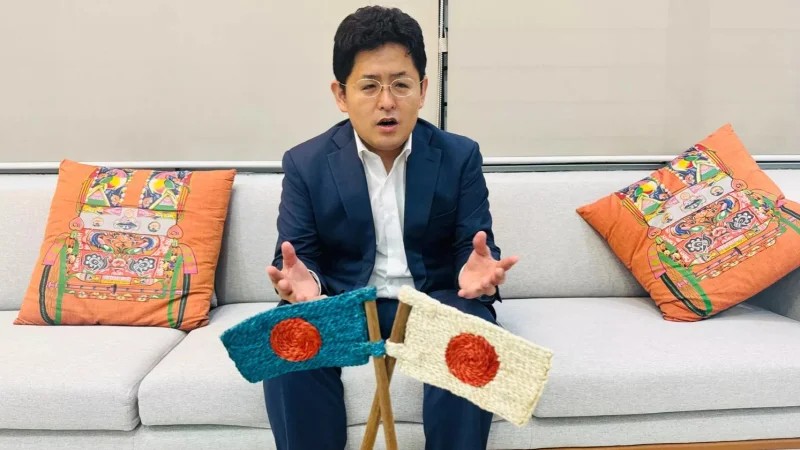
If Bangladesh Prime Minister Tarique Rahman visits Japan, it could open new investment opportunities for Bangladesh, Japan External Trade Organization (JETRO) Country Representative Kazuiki Kataoka has said. Kataoka noted that Japanese companies are preparing to reaffirm their long-term commitment to the country amid renewed confidence in its political stability.
Although Bangladeshi media report that a visit is expected to take place soon, neither Bangladesh nor Japan has issued an official announcement regarding the matter so far.
In an exclusive interview with UNB, Kataoka stated that the formation of a new government in February has improved the investment climate, encouraging major Japanese companies and senior executives to visit Bangladesh, assess the market, and conduct feasibility studies for potential investments.
“In comparison with the last interim government, we can say that there is one big improvement. That is political and social stability. So, we couldn't invest in this country actively last year,” he stated.
Kataoka, recently elected president of the Japan-Bangladesh Chamber of Commerce and Industry (JBCCI), stated that investors have remained cautious under the interim government due to uncertainty surrounding political stability, as well as potential changes to investment policies, regulations, and incentives.
Kataoka stated that while the interim government of Bangladesh successfully concentrated on holding the national election, uncertainty surrounding the policies and incentives of the incoming administration made it difficult for investors to evaluate long-term business prospects.
The formation of the new government has helped restore confidence, with large Japanese companies and senior officials increasingly exploring business opportunities in Bangladesh.
Citing a recent development, he stated that Toyota Tsusho Corporation, the trading arm of the Toyota Group, has expressed interest in exploring the possibility of assembling cars in Bangladesh.
He described the interest as a positive development for bilateral economic relations, noting that it reflects the growing attention major Japanese businesses are paying to Bangladesh’s manufacturing potential.
Around 340 to 350 Japanese companies are currently operating in Bangladesh, and interest in trade and investment is increasing, he said.
Bangladesh remains attractive both as an export-oriented manufacturing base and as a consumer market, given its large population and growing economic potential.
Kataoka said that some Japanese companies are also considering shifting production from other countries, including China, to Bangladesh, highlighting the country's potential to become a more important manufacturing hub.
“Bangladesh is still a very good and popular destination for manufacturers looking to produce goods for export. At the same time, the country has an attractive domestic market that Japanese investors are increasingly interested in exploring,” he said.
Despite the improved political environment, Japanese investors continue to face challenges involving customs clearance, taxation, payments, and visa processing, according to Kataoka.
JETRO has been raising these concerns with relevant government agencies, including Invest Bangladesh, and advocating reforms to make the country more attractive to foreign direct investment (FDI).
He said the government appeared serious about attracting foreign investment, recognizing its role in expanding the economy, introducing new technologies, facilitating technology transfer, and promoting innovation.
Finance Minister Amir Khosru Mahmud Chowdhury emphasized the importance of foreign direct investment in developing the domestic economy, he noted.
However, a gap between policymakers and officials responsible for implementing decisions, alongside slow implementation, remains a concern for investors.
Kataoka said, “We have to work together to improve the investment environment. If existing investors are satisfied, they will become ambassadors for new investors, helping us bring more investment from Japan.”
He stressed that improving the experience of companies already operating in Bangladesh would be crucial to attracting further investment.
Kataoka urged Bangladesh to give greater priority to developing upstream industries, particularly steel and chemicals, to support investment in electronics, automobiles and other advanced manufacturing sectors.
While the country has focused heavily on the ready-made garment (RMG) industry and is seeking to attract investment in sectors such as electronics and automobiles, the development of supporting industries is essential to make such investments commercially viable, he said.
“Without upstream industries, it will be difficult to develop downstream industries,” he said.
Bangladesh remains dependent on imports for several industrial materials, including high-quality steel and chemicals, increasing production costs through tariffs and other expenses.
Local steel manufacturers have made progress, yet the industry continues to rely on imported scrap steel. Advanced manufacturing, meanwhile, requires access to higher-quality materials and industrial inputs.
These materials are essential for producing components used in automobiles, electronics and other manufactured goods, he said.
Kataoka cautioned that ongoing high production costs may erode Bangladesh’s ability to compete with Vietnam and Indonesia for foreign investment.
Developing upstream industries would require substantial capital investment and coordinated government support, as individual companies might not be able to overcome the challenges independently, he said.
Once these industries are established, he said, Bangladesh would be better positioned to expand into higher-value manufacturing and attract investment in more sophisticated sectors.
Kataoka also highlighted the importance of the Economic Partnership Agreement (EPA) signed between Bangladesh and Japan in February, expressing hope that it would enter into force as soon as possible.
He noted that while tariff reductions are an important component of the agreement, its advantages also encompass customs procedures and intellectual property protection.
More efficient customs clearance could facilitate trade, while stronger intellectual property protection could help curb counterfeit products and protect legitimate businesses.
Kataoka cited counterfeit automotive parts, motorcycle-related products and soy sauce as examples of goods that could undermine original manufacturers and prevent them from receiving fair returns on their investments.
He stated, "Effective implementation of the EPA would help establish a more transparent and rules-based market, benefiting businesses and consumers in both countries."
Bangladesh and Japan will also need to monitor implementation of the agreement's provisions once it enters into force, to ensure businesses can realize its intended benefits.
On the future of bilateral relations, the representative said Japan would continue to regard Bangladesh as an important partner, regardless of changes in government.
The two countries should strengthen not only government-to-government relations but also people-to-people connections, Kataoka said.
Over the years, Japan has maintained friendly relations with Bangladesh, and he expressed confidence that the relationship would remain strong over the next five years.
The representative said the priority would be to build on the existing friendship and deepen cooperation with the current government while maintaining strong ties with the people of Bangladesh.
Kataoka, the newly elected president of the Japan‑Bangladesh Chamber of Commerce and Industry (JBCCI), said the chamber would work to deepen business links between Japanese and Bangladeshi companies and create opportunities for new partnerships.
The chamber plans to organize seminars, workshops and roundtable discussions highlighting Japan’s contributions to Bangladesh in infrastructure, education, healthcare and other sectors.
It will also seek to expand networking opportunities for Bangladeshi businesses interested in working with Japanese companies.
Joint events involving the JBCCI and other Japanese business organizations could help companies identify potential partners and explore opportunities beyond their existing business relationships, he said.
Kataoka said stronger business connections would complement the two countries’ longstanding diplomatic relationship.
Why it matters
The statements by JETRO's representative highlight how political stability under the new government is revitalizing Japanese investor confidence and economic cooperation with Bangladesh.