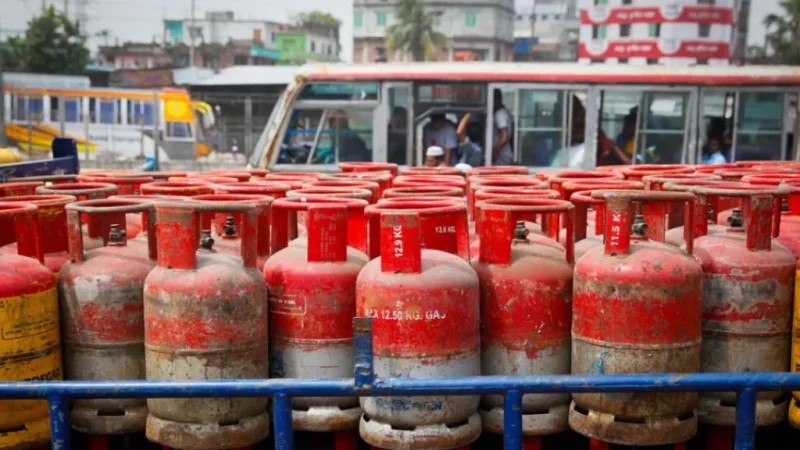
Consumers are growing worried over the latest LPG price hike as shortages persist across the country, with 12-kg cylinders being sold for Tk 2,200 to Tk 2,500 in areas where gas is available. This is far above the newly announced official price of Tk 1,837.
On Sunday, the Bangladesh Energy Regulatory Commission (BERC) announced a fresh increase in consumer-level Liquefied Petroleum Gas (LPG) prices, raising the cost of a 12-kilogram cylinder by Tk 252 to Tk 1,837.
However, field reports indicate that consumers across the country are already trapped in a chaotic retail market where 12-kilogram cylinders are selling for between Tk 2,200 and Tk 2,600—up to Tk 1,000 above government-fixed benchmarks—while many retail outlets have run completely out of stock.
While state-owned LP Gas Limited (LPGL) maintains a price of Tk 777 for its 12.5-kilogram cylinder, its negligible market share leaves more than 98 percent of the country's bottled gas consumers entirely dependent on private distributors.
The price hike comes just a day after Power, Energy and Mineral Resources Minister Iqbal Hassan Mahmood and Commerce Minister Khandakar Abdul Muktadir held an urgent meeting with LPG importers at the Secretariat on Saturday to address the deteriorating market situation.
This high-level intervention follows a September 30 directive issued by the Energy Minister to Deputy Commissioners (DCs). The Minister instructed them to investigate whether market syndicates are engineering an artificial crisis and to take strict legal action against those who gouge prices.
Industry insiders and energy experts attribute the unprecedented supply strain to a severe shortfall in national pipeline natural gas.
According to Petrobangla, against a nationwide demand of nearly 4,000 million cubic feet per day (MMCFD), current domestic extraction and LNG regasification deliver only around 2,600 MMCFD.
The resulting power cuts and pipeline gas shortages have forced thousands of households, commercial eateries, and small industries to switch to bottled LPG. This shift has created a surge in demand that existing private distribution networks are struggling to meet.
Compounding local issues, private importers cite mounting international headwinds.
Saudi Aramco increased its Contract Price (Saudi CP) for September to $625 per ton for propane and $660 per ton for butane.
More critically, global liquefied petroleum gas availability has tightened as a result of Middle East geopolitical conflicts, which has driven ocean freight rates to record highs.
Importers stated that while the Bangladesh Energy Regulatory Commission (BERC) calculated retail prices using a freight benchmark of $160 per ton, actual international shipping costs have surged to $400 per ton. This discrepancy has forced several private operators to curtail their import volumes in order to prevent heavy financial losses.
The market crisis has also triggered internal friction within the LPG sector.
Official reports indicate that liquefied petroleum gas (LPG) imports dropped from nearly 160,000 tons in August to around 120,000 tons in September.
However, a group of liquefied petroleum gas operators submitted a formal letter to the Energy Division on October 1, claiming that import volumes remained steady.
They alleged that certain major importers deliberately delayed offloading and releasing imported LPG cargoes to generate artificial market pressure and inflate prices, demanding an independent inquiry into the bottleneck.
As winter approaches—a season traditionally marked by a seasonal rise in global heating fuel demand—consumers and industry stakeholders have warned that Bangladesh's LPG market could face even deeper instability in the coming months without strict market monitoring and streamlined import support.
Denouncing the price hike, Consumers Association of Bangladesh (CAB) Energy Adviser Prof M Shamsul Alam termed the Bangladesh Energy Regulatory Commission's (BERC) decision a "validation of illegal market manipulation."
He stated that raising official prices while failing to enforce retail compliance only shields dishonest syndicates without ensuring gas availability for ordinary citizens.
Energy expert and former BUET professor Dr Ijaz Hossain highlighted the policy oversight behind the crisis. He emphasized that shifting the nation's energy demand from depleted domestic pipeline gas to imported liquefied petroleum gas (LPG), without expanding state-owned buffer stocks or establishing a price stabilization fund, leaves consumers at the mercy of private cartels and volatile global freight markets.
Why it matters
The steep LPG price hike and severe supply shortages increase financial burdens on consumers across Bangladesh who depend on bottled gas due to piped natural gas shortfalls.