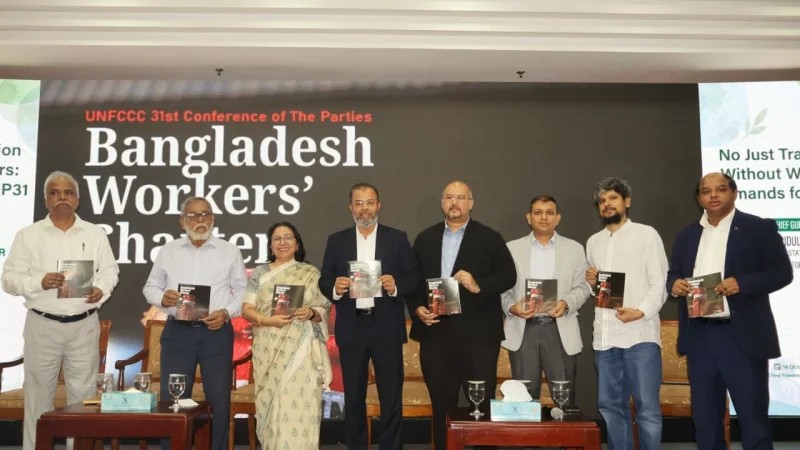
Ahead of the UN climate conference COP31, workers in Bangladesh have called for greater representation in international climate negotiations, fair compensation for climate-related losses, and stronger safeguards for their livelihoods.
The Bangladesh Workers’ Charter for COP31 was unveiled in Dhaka on Wednesday by the National Alliance for Just Transition Bangladesh (NAJTB), in collaboration with the Manusher Jonno Foundation (MJF) and the Bangladesh Labour Foundation (BLF). The document outlines 23 demands across eight negotiation tracks.
The charter highlights the growing threats posed by extreme heat, climate-induced displacement and industrial decarbonisation, particularly to informal workers, women and communities dependent on climate-sensitive sectors.
Speakers at the event urged the government to include workers, particularly women, in Bangladesh’s official COP31 delegation. They also called for assurances that the transition to a greener economy will not undermine workers’ rights, wages, or job security.
Syed Sultan Uddin Ahmmed, executive coordinator of NAJTB and executive director of the Bangladesh Institute of Labour Studies (BILS), stated that workers made significant contributions to the national economy but bore the consequences of a climate crisis they had done little to cause.
Rejecting debt-based climate finance and charity-driven approaches, he called for compensation commensurate with actual losses and meaningful worker participation in decisions affecting their jobs and livelihoods.
Shaheen Anam, executive director of MJF, stated that informal workers, who represent approximately 84% of Bangladesh’s workforce, faced disproportionate risks from climate change.
She called for income protection, job security, decent working conditions, and targeted support for women, noting that they frequently shoulder additional unpaid care responsibilities while simultaneously facing the risk of technological displacement.
Anam also urged the government to include a woman worker in Bangladesh’s COP31 delegation, referring to the prime minister’s instruction to ensure worker representation.
AKM Ashraf Uddin, member secretary of NAJTB and executive director of BLF, stated that a green transition would fail to be sustainable if workers were to lose their jobs, wages, and opportunities to participate in climate negotiations.
He called on the government, the International Labour Organization (ILO) and international development partners to ensure that workers’ concerns were reflected in COP31 discussions.
Presenting the keynote paper, Mir Mohammad Ali, an assistant professor at Sher-e-Bangla Agricultural University, outlined the growing impact of climate change on employment and livelihoods.
Citing World Bank estimates, he stated that Bangladesh lost approximately 250 million workdays to heat-related illness in 2024, highlighting the economic toll of rising temperatures and unsafe working conditions.
The charter was developed through eight consultations involving 43 organisations. It calls for stronger social protection, safer workplaces, greater worker participation in climate policymaking, and adequately funded programmes to retrain workers affected by the shift to a low-carbon economy.
Anowar Hossen, chief coordinator of NAJTB, called for collective action to address climate-related loss and damage and to protect workers in vulnerable communities.
Addressing the event, State Minister for Environment, Forest and Climate Change Shaikh Faridul Islam described the charter as timely and comprehensive.
He said the ministry would make every effort to incorporate relevant demands into national and local climate policies, as well as Bangladesh’s position paper for COP31.
The state minister also said the government had initiated measures to generate 4,000 megawatts of solar power within three months, including 296MW in Dhaka district, highlighting the potential of renewable energy development to create jobs.
Speakers stressed that expanding renewable energy alone will not ensure a just transition.
They said this requires adequate worker protection, training and participation opportunities in the emerging green economy.
A panel discussion moderated by Shaheen Anam included Dr Mohammad Emran Hasan, head of climate justice and natural resource rights at Oxfam in Bangladesh, and Md Shamsul Islam, deputy secretary at the Ministry of Labour and Employment.
The panel also featured Mir Mohammad Ali and Rajekuzzaman Ratan of the Socialist Workers Front (SSF), who additionally coordinates NAJTB.
The panellists underscored unequal access to climate finance, occupational exposure to extreme heat, technological displacement and gaps in labour protection.
They called for grant-based climate finance, evidence-based compensation for climate-related losses and greater inclusion of women and informal workers in climate policymaking.
Shakil Akhter Choudhury, NAJTB coordinator and representative of Sramik Karmachari Oikya Parishad (SKOP), presented the charter, which sets out workers’ priorities across eight negotiation tracks ahead of COP31.
The demands aim to place workers’ rights and livelihoods at the heart of climate action, encompassing decisions on adaptation, loss and damage, climate finance, and the transition away from carbon‑intensive industries.
The charter’s central message is that workers must not be left to bear the economic and social costs of climate policies without adequate support or a meaningful role in shaping them.
Among those attending the event were Max Tunon, ILO country director in Bangladesh; Amer Salim, chairman of the Standing Committee on Just Transition at the Bangladesh Garment Manufacturers and Exporters Association (BGMEA); Md Shamsul Islam of the Ministry of Labour and Employment; and Zubaer Alam, programme officer at BLF.
As Bangladesh prepares for COP31, the charter calls for a negotiated just transition that recognises workers not merely as victims of climate change but as essential stakeholders in decisions affecting employment, workplace safety and future livelihoods.
Why it matters
The charter ensures that informal workers, who constitute a large share of Bangladesh’s labor force, are protected and given a voice in the global climate transition.