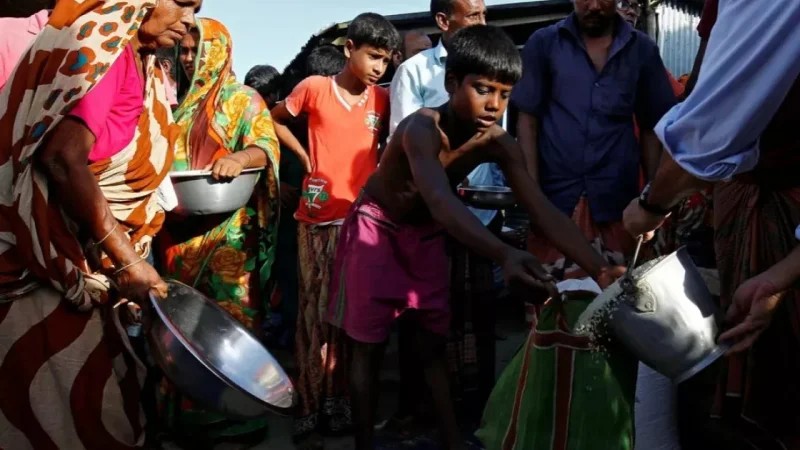
Bangladesh has ranked 84th in the Global Hunger Index (GHI) 2026, recording a score of 19.2 that places the country within the "moderate" hunger category.
The index assesses hunger and undernutrition using four indicators: undernourishment, child stunting, child wasting and under-five mortality.
Bangladesh was ranked ahead of India and Pakistan, but behind Nepal, in the index, which assesses hunger and undernutrition across countries.
India ranked 100th with a score of 24.1, while Pakistan stood at 106th with a score of 25.5. Both countries fell into the “serious” hunger category, according to the report.
Nepal ranked 72nd with a score of 14.5, placing it in the “moderate” category.
A lower Global Hunger Index (GHI) score indicates a lower level of hunger, while the rankings reflect countries' relative positions among those included in the assessment.
The Global Hunger Index is published annually by Concern Worldwide, Welthungerhilfe, and the Institute for International Law of Peace and Armed Conflict (IFHV) to track hunger and undernutrition worldwide.
The 2026 report warns that global hunger is rising again, with conflicts, climate shocks, and economic crises threatening food security.
In Bangladesh, 8.2% of the population is undernourished, while 24% of children under the age of five suffer from stunting, which is defined as low height for their age.
The report also shows that 12.9% of children under the age of five suffer from wasting, which is defined as low weight for their height. Additionally, 3% of children die before reaching their fifth birthday.
Bangladesh has made progress in reducing child stunting over the past two decades.
The proportion of children under five affected by stunting fell from 54.9% in 2000 to 24% in the latest assessment, representing a reduction of 30.9 percentage points.
Under the GHI classification, scores below 10 indicate low hunger, scores from 10 to 19.9 indicate moderate hunger, scores from 20 to 34.9 indicate serious hunger, scores from 35 to 49.9 indicate alarming hunger, and scores of 50 or above indicate extremely alarming hunger.
The Global Hunger Index is published annually by Concern Worldwide and Welthungerhilfe to measure and track hunger and undernutrition worldwide.
According to the index, a lower score indicates a lower level of hunger, while a country’s ranking depends on its position relative to other countries included in the assessment.
Why it matters
The Global Hunger Index 2026 ranking highlights Bangladesh's nutritional progress and ongoing public health challenges relative to regional peers.