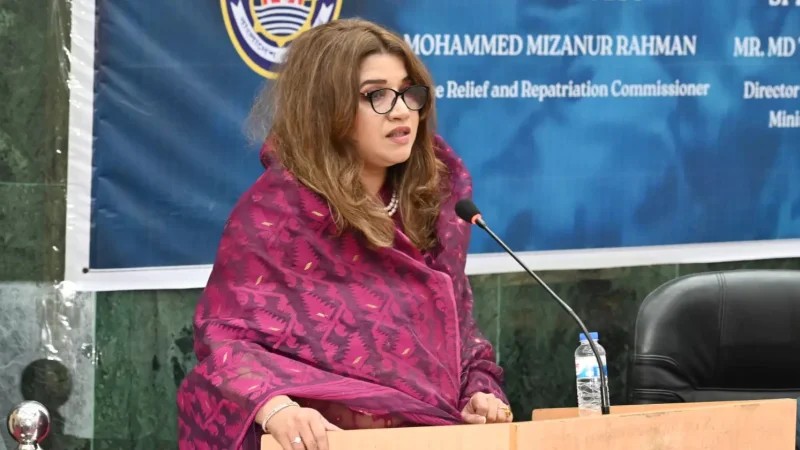
Bangladesh’s State Minister for Foreign Affairs Shama Obaed Islam warned on Wednesday that rising crime and insecurity affecting host communities in Cox’s Bazar cannot be allowed to become the new normal.
Speaking as chief guest at the National Policy Dissemination Program on “Uncertain Return: Rohingya Voices on Repatriation Barriers,” organized by the University of Dhaka’s Department of Criminology and the Criminology Research Forum at the Senate Bhaban, she emphasized that the solution to the Rohingya crisis lies in Myanmar and that Bangladesh cannot sustain the situation indefinitely.
The state minister called on the international community to move from statements of support to actionable and predictable assistance, recalling Prime Minister Tarique Rahman’s address at the 81st UNGA, where he outlined five urgent priorities: a credible roadmap for sustainable repatriation, an end to violence, justice, accountability, and stronger action against transnational crimes.
She noted the formation of a National Strategy Formulation Committee to guide the safe and dignified return of the forcibly displaced Myanmar nationals (FDMNs), identifying recognition and identity, land and property, security, and trust with credible guarantees as the pillars of a credible roadmap.
“Repatriation is an act of trust,” she said, adding that the Rohingyas are asking for rights, not charity.
A research study conducted by the Department of Criminology, which surveyed 816 Rohingya respondents across 17 camp sites in Ukhiya, Cox’s Bazar, and included 72 in-depth interviews with stakeholders, found that the Rohingyas are not rejecting Myanmar as their home but are rejecting a return to the conditions that forced them to flee.
The state minister also distributed prizes among winners of an essay competition organized by the Department of Criminology during the event.
Why it matters
Bangladesh's top foreign affairs official has publicly linked Cox's Bazar insecurity to the broader Rohingya repatriation challenge, signaling renewed diplomatic pressure on Myanmar and the international community.