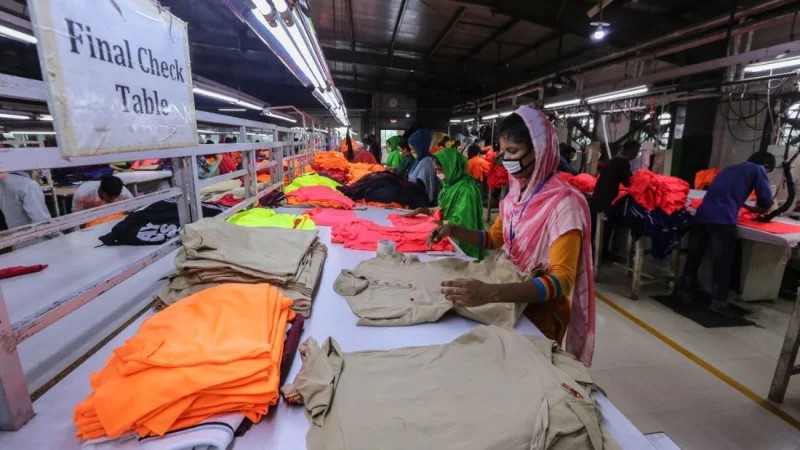
Women make up 48.5% of the workforce across 25 assessed textile mills in Bangladesh, yet they remain underrepresented in wet processing as well as supervisory and managerial roles. This finding was revealed in a gender assessment presented on Monday at a national consultation held in Dhaka.
The consultation on the Gender Action Plan in the Textile Sector was organized by the Environment and Social Development Organization (ESDO), in collaboration with the Department of Environment (DoE) and project partners. The event was held to strengthen gender-responsive chemical management and occupational health and safety within the industry.
Held under the project “Reducing Uses and Releases of Chemicals of Concern, Including Persistent Organic Pollutants (POPs), in the Textiles Sector,” the event brought together government officials, technical experts and other stakeholders to discuss workplace risks and identify measures to improve chemical safety and women's participation in decision-making.
Speaking at the event, Regional Gender Expert Dr Khondaker Golam Moazzem stated that women made up 48.5% of the workforce across the 25 assessed textile mills, yet they continued to be underrepresented in wet processing as well as supervisory and managerial positions.
He stated that gender-responsive chemical safety measures must address the specific occupational risks faced by women, guarantee equal access to safety training as well as appropriate personal protective equipment (PPE), and ensure that women are included in workplace decision-making.
The consultation featured findings from the national gender assessment and a draft National Gender Action Plan (NGAP). Participants discussed gaps in chemical safety information, protective equipment, occupational health and safety training, reproductive health, and sex-disaggregated data.
National Gender Expert Siddika Sultana stated that the assessment uncovered shortcomings in several areas, specifically including gender-responsive risk assessments, the provision of personal protective equipment (PPE), safety training, and reproductive health measures.
She stated that the draft action plan establishes a framework featuring specific actions, defined responsibilities, and measurable targets. However, she noted that effective implementation will necessitate shared ownership among government agencies, factory management, and workers.
In his welcome address, Department of Environment Deputy Director and National Focal Point Kazi Suman stated that a regional project involving Bangladesh, Indonesia, Pakistan, and Vietnam was designed to reduce the use of hazardous chemicals within the textile industry.
The initiative involves preparing chemical inventories in 125 factories, according to his statement. He noted that safer alternatives have so far been introduced in two of these facilities, alongside various capacity-building activities.
National Project Coordinator Dr Mahfuzul Haque stated that Bangladesh's textile sector employed more than three million workers, a large portion of whom were women. He added that workers faced exposure to chemicals of concern and persistent organic pollutants, which studies have connected to reproductive health risks for both male and female workers.
Dr Anton Purnomo, director of the Basel and Stockholm Conventions Regional Centre for South-East Asia (BCRC-SEA) in Indonesia, stated that the project was designed to reach 10,000 direct beneficiaries across the region, with 60% of them being women.
He outlined three priorities: gender-responsive occupational health and chemical safety, greater participation and opportunities for women, and sustainable interventions supported by measurable indicators and clear timelines.
Speaking as the chief guest, Dr Md Saidur Rahman, additional secretary at the Ministry of Environment, Forest and Climate Change, stated that the Environment Conservation Rules 2023 establish standards for 15 chemicals across 13 industrial sectors, which include textile dyeing and washing.
He stated that the government aimed to collaborate with industries to decrease chemical usage instead of depending entirely on enforcement.
He also urged the Department of Environment to ensure that textile factories operated both biological and chemical effluent treatment plants (ETPs). He noted that wastewater from dyeing and washing continued to pollute the Turag, Shitalakkhya and Buriganga rivers.
ESDO Senior Technical Adviser Professor Dr Shahriar Hossain stated that gender considerations should be addressed through equity and justice rather than focusing exclusively on women, as the project encompassed all workers, employees and management personnel exposed to chemicals.
He said the initiative did not aim to eliminate chemicals entirely or identify per- and polyfluoroalkyl substances (PFAS) without laboratory testing. Rather, it evaluated current chemical usage and tested safer alternatives in selected factories to promote a transition to greener chemicals.
Women account for nearly half of the textile workforce but remain underrepresented in chemical-intensive wet processing jobs, consultation moderator and Department of Environment Director Parvez Chowdhury said in his closing remarks.
“The solution is not to exclude women, but to make every workplace safe for them,” he said.
The consultation sought to convert the gender assessment findings into a practical action plan. It outlined clear responsibilities, timelines, indicators and monitoring arrangements.
ESDO and its partners said the initiative sought to strengthen institutional accountability, improve women's access to safety measures and training, and promote their participation in occupational health and safety initiatives across Bangladesh's textile sector.
Why it matters
The consultation highlights the need for gender-responsive safety measures in a sector employing over 3 million workers, mostly women, who face reproductive health risks from chemical exposure.