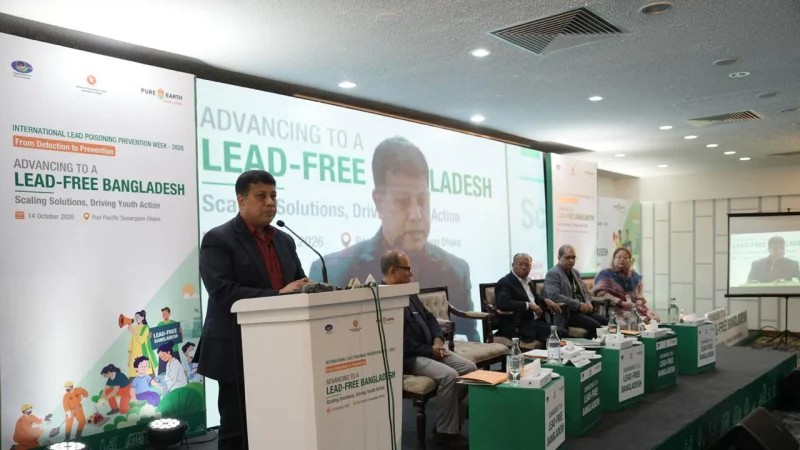
Speakers at a seminar in Dhaka on Wednesday stated that coordinated action across environmental monitoring, industrial safety, and public health is necessary to curb lead exposure in Bangladesh.
They stressed the need for stronger environmental monitoring, safer industrial practices, remediation of contaminated sites, and public health interventions to implement the country's national strategy to prevent lead exposure.
The seminar, titled “Advancing to a Lead-Free Bangladesh: Scaling Solutions, Driving Youth Action,” was organized by the Ministry of Environment, Forest and Climate Change (MoEFCC) and the Department of Environment (DoE), in collaboration with Pure Earth Bangladesh, to mark the 14th International Lead Poisoning Prevention Week.
Held under the theme “From Detection to Prevention,” the event brought together government officials, researchers, development partners, civil society representatives and young people.
Chief guest and Environment, Forest and Climate Change Minister Abdul Awal Mintoo stated that the National Strategy and Multi-Year Action Plan for a Lead-Free Bangladesh 2026–2035 must be translated into funded work plans, capable institutions, and measurable outcomes.
He called for sustained investment in testing facilities, laboratories, environmental monitoring, pollution-site remediation and safer industrial practices, alongside stronger public health responses. He also urged development partners and the private sector to support technology transfer, training and research.
The Cabinet approved the strategy on August 17, setting targets to reduce the proportion of children with elevated blood lead levels by 50% by 2030 and by 95% by 2035.
Mitali Das, country director of Pure Earth Bangladesh, stated that the organization is collaborating with the government and other stakeholders to advance an extended producer responsibility (EPR) directive for lead-acid batteries. The proposed directive is designed to strengthen battery collection, traceability, and environmentally sound recycling.
“Informal lead recycling is not good business when its profits come at the expense of children's health, government revenue and the environment,” she stated.
Citing global research, Mitali stated that lead exposure was estimated to have caused approximately $28.6 billion in health-related economic losses in Bangladesh in 2019, which is equivalent to 6% to 9% of the country's gross domestic product.
Mohammed Solaiman Haider, additional director general of the Department of Environment (DoE), stated that the department was developing standard operating procedures and technical guidelines for the lead-acid battery industry to support inspections, monitoring, pollution control, and regulatory compliance.
A technical working group has also been formed to establish permissible soil lead limits, he said.
Dr Quazi Ahmed Zaki, director of the Institute of Epidemiology, Disease Control and Research, called for stronger public health procedures to investigate lead exposure and respond to affected communities. He noted that lead can cause harm before symptoms become apparent.
Participants attended a seminar titled "Advancing to a Lead-Free Bangladesh: Scaling Solutions, Driving Youth Action" in Dhaka on Wednesday, October 14, 2026. Photo: Courtesy
During a keynote presentation, Aftab Uz Zaman Khan, senior programme manager at Pure Earth Bangladesh, outlined interventions supporting the national strategy and shared findings from a lead-remediation initiative at SSR School in Labanchora, Khulna.
Endline tests conducted in September 2026 found a 17.5% reduction in median blood lead levels among 111 participants tested both before and after the intervention. The median fell from 5.32 micrograms per decilitre in 2025 to 4.39 micrograms per decilitre.
The seminar also showcased youth-led approaches to lead pollution prevention. Sheikh Sajidul Islam of the Islamic University of Technology, a joint winner of the “Local Action for Lead-Free Communities: Youth-Led Solutions” competition, presented a poster titled “Surjo Garage: Turning Dhaka’s Dead E-rickshaw Batteries into a Lead-Free Switch.”
Winners of the youth solutions competition and the “Art for a Lead-Free Tomorrow” competition received awards.
The gathering also featured the launch of the National Youth Alliance for a Lead‑Free Bangladesh, aimed at mobilising young people for prevention, advocacy and public awareness.
Pure Earth Bangladesh has handed over two portable X-ray fluorescence (XRF) analysers to the Department of Environment (DoE). The devices can rapidly detect lead and other heavy metals on solid surfaces, supporting environmental monitoring and enforcement efforts.
Mohammad Navid Safiullah, additional secretary of the MoEFCC, chaired the event. In his closing remarks, he said cooperation with Pure Earth offered a framework for technical collaboration on lead pollution prevention.
“The research, technical initiatives and youth participation presented today should feed into the wider implementation process. Their value will grow when lessons are shared with the institutions responsible for acting on them,” he said.
More than 100 representatives from government agencies, UN bodies, development partners, academia, civil society, the private sector, youth organisations and the media attended the seminar.
Why it matters
Implementation of the national lead-free strategy aims to significantly reduce childhood lead poisoning and mitigate billions of dollars in health-related economic losses in Bangladesh.