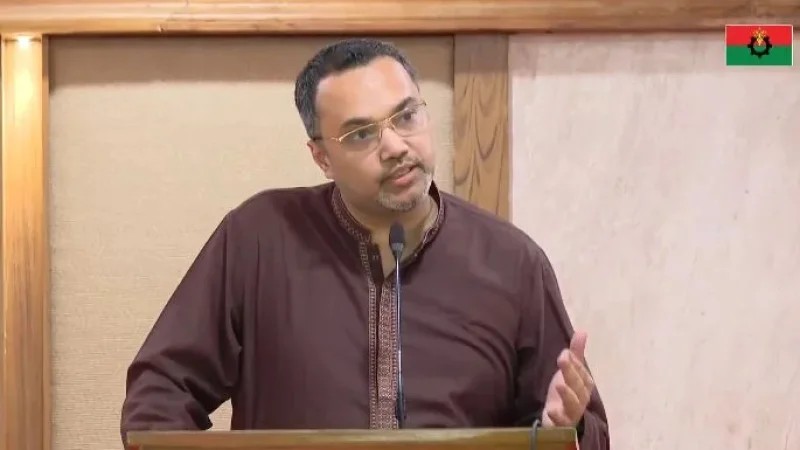
During his four‑day trip to New York for the 81st United Nations General Assembly, Prime Minister Tarique Rahman underscored Bangladesh’s national interests and sovereignty and outlined the country’s goals for partnership, investment, trade and inclusive development before the international community, Prime Minister’s Adviser Mahdi Amin said on Wednesday.
At a press conference in the Karabi Hall of the Prime Minister’s Office in Tejgaon, the prime minister said that over the past four working days he had firmly presented Bangladesh’s interests and potential to the international community across various fields, while emphasizing the country’s sovereignty and independence.
Mahdi, the spokesperson for the Prime Minister’s Office, said the prime minister participated in 30 official programmes during his four‑day visit to New York, held bilateral meetings with 11 countries and delivered six speeches at various events, in addition to his main address at the General Debate of the 81st United Nations General Assembly.
He said the prime minister travelled with a 35‑member official delegation, comprising 15 ministers together with state ministers, advisers and special assistants.
Mahdi said that members of the delegation took part in roughly 50 additional meetings during the visit, raising the total number of bilateral and multilateral engagements involving Bangladesh’s representatives to more than 80.
He added that a smaller delegation has also traveled to California to seek cooperation with the United States technology industry and academic institutions.
Out of the prime minister’s thirty official programmes, eight were directly linked to the United Nations. They comprised the opening of the 81st UN General Assembly, his General Debate address, a breakfast hosted by UN Secretary‑General António Guterres, a reception hosted by U.S. President Donald Trump, and four high‑level side events.
In his first speech to the United Nations General Assembly, the prime minister outlined Bangladesh’s priorities, citing democracy, accountability, transparency, inclusive development, human rights, the rule of law, freedom of expression, economic recovery, employment, health, education, technology and climate action.
He detailed the government’s three‑R strategy—recovery, restoration and reconstruction—and introduced initiatives such as the Family Card, Farmer Card, Health Card and a proposed Universal Card.
Mahdi said the prime minister underscored the nation’s agenda to develop human capital, generate employment, foster entrepreneurship and broaden the deployment of artificial intelligence and robotics.
He outlined a roadmap for a prosperous, self‑reliant and welfare‑oriented Bangladesh, stressing that the benefits of development must reach people across all sections of society, Mahdi said.
During the visit, climate action featured prominently. In high‑level discussions on climate action, a just transition and sea‑level rise, the prime minister outlined Bangladesh’s agenda, which includes planting 250 million trees within five years, excavating 20,000 km of canals, advancing the Teesta Master Plan and the Padma Barrage project, expanding solar and other renewable‑energy capacity and fostering green industries, he said.
The prime minister also called for stronger international action on climate resilience, climate finance and the Loss and Damage Fund.
At a Bangladesh‑co‑organized high‑level event on midwifery and maternal health, Mahdi reported that the prime minister announced a plan to recruit 100,000 healthcare workers, with women projected to comprise 80 % of the new hires. The prime minister also emphasized the need to extend healthcare services beyond the union level to upazila, district and divisional tiers.
He said the Rohingya crisis also received particular attention, noting that at a high‑level side event co‑convened by Bangladesh and The Gambia, the prime minister unveiled a five‑point roadmap for early, safe, voluntary, dignified and sustainable repatriation, together with measures on humanitarian support, rights and security, justice and accountability, and regional and international cooperation.
Mahdi said the roadmap was positively received by the stakeholders attending the event and could serve as a framework for future discussions.
The official said Myanmar was not directly engaged on the platform, but that they had spoken with all stakeholders present at the United Nations event. He noted that the prime minister’s five‑point roadmap was broadly accepted.
He added that, based on future conversations with the UN and other stakeholders, Bangladesh’s engagement will be strengthened and the roadmap may serve as an important framework for those discussions.
Mahdi said that, in the sphere of bilateral diplomacy, the prime minister held meetings with representatives from eleven countries, covering topics that included equality, fairness, dignity, people‑to‑people relations, health, education, travel, manpower exports, and trade and investment.
He said that talks with Middle Eastern nations emphasized manpower exports, trade and investment, whereas meetings with South Asian nations centered on regional cooperation, stability and democracy.
According to him, the prime minister also met with the United Nations Secretary‑General, other UN officials, the president of the World Bank, representatives of the Gates Foundation, officials of the International Peace Institute and leading Wall Street investors.
Mahdi said the UN Secretary‑General congratulated the prime minister on his electoral victory and praised Bangladesh’s contributions to UN peacekeeping, as well as its humanitarian role in hosting the Rohingya refugees.
The World Bank discussed technical and financial support for Bangladesh’s development programs, while talks with approximately 25 leading Wall Street investors focused on investment in Bangladesh’s financial sector and the introduction of bonds and other financial instruments, he said.
The adviser stated that the prime minister also met with representatives from Boeing against the backdrop of the government's agreement to purchase 11 aircraft.
He said the prime minister’s spouse, Dr Zubaida Rahman, also had a busy schedule, participating in eight programs and delivering three speeches. She attended the Women Leaders platform, the First Spouses’ Dialogue, the midwifery event, a program hosted by US First Lady Melania Trump and the UN Secretary-General’s breakfast, among others, he added.
When asked about the message Bangladesh conveyed to the international community, Mahdi stated that the prime minister detailed the nation's democratic journey and plans for a self-reliant, modern, and welfare-oriented state. Additionally, she outlined Bangladesh's contributions to promoting global peace.
Mahdi stated that the Prime Minister made it clear Bangladesh desires bilateral and multilateral cooperation rooted in equality, fairness, mutual interest, and dignity, alongside the guarantee of the rule of law, human rights, and freedom of expression.
He stated that the primary aim of the prime minister’s visit to the UNGA was to present Bangladesh’s interests and potential while simultaneously expanding opportunities for international partnership.
“Everywhere the prime minister went, Bangladesh’s national interests and sovereignty remained at the forefront. We want partnership, investment and trade with different countries so that we can ensure self-reliance, economic strength and inclusive development,” he said.
Also present at the press conference were Prime Minister’s Press Secretary AAM Saleh Shibly, Additional Press Secretary Atikur Rahman Ruman, Prime Minister’s Speech Writer Mahfuzur Rahman, Deputy Press Secretary Hasan Shiplu, Deputy Press Secretary Md Suzauddhowla (Sujan Mahmud), Assistant Press Secretary Shahriar Pamir, and Assistant Press Secretary KM Nazmul Haque.
Why it matters
The visit directly showcases Bangladesh’s sovereign interests and global partnership opportunities, reinforcing its development agenda and international standing.