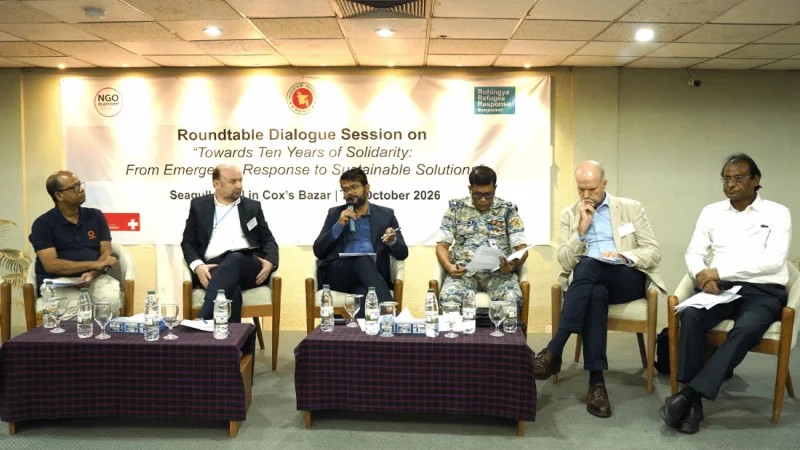
As the Rohingya humanitarian response approaches its 10th year, the NGO Platform in Cox’s Bazar has appealed for sustained international solidarity, stronger localization, and increased investment in both resilience and host communities.
The call was issued during a high-level roundtable entitled “Towards Ten Years of Solidarity: From Emergency Response to Sustainable Solutions.” The gathering brought together government representatives, Rohingya community leaders, host-community representatives, United Nations agencies, donors, non-governmental organizations, civil society members, and various other humanitarian stakeholders.
Held in Cox’s Bazar, the dialogue focused on lessons learned from nearly a decade of humanitarian response, the most pressing needs facing Rohingya refugees and host communities, and ways to transition from an emergency response toward sustainable and durable solutions.
Hosted by Plan International Bangladesh since May 2026, the NGO Platform brings together 182 local, national and international non-governmental organizations working in the Rohingya response.
Participants emphasized the necessity of learning from nearly a decade of humanitarian action while simultaneously adapting to the changing context and emerging needs of affected communities.
Discussions focused on strengthening dignity and resilience, addressing persistent gaps and improving coordination among humanitarian, development and other actors.
A key message emerging from the roundtable was that solutions should be shaped collaboratively with affected communities rather than developed solely on their behalf.
The participation of Rohingya representatives and host-community leaders alongside government officials, NGOs, UN agencies, development partners, and civil society representatives was aimed at ensuring that community perspectives were reflected in discussions regarding future priorities.
The roundtable was organized around two strategic sessions. The first focused on the current needs and priorities of Rohingya and host communities, with participation from community representatives, non-governmental organizations, civil society, and media.
The second brought together government and UN representatives for discussions on resilience, collective action and durable solutions.
Participants also highlighted the need to keep the aspirations of Rohingya children and young people at the center of future strategies.
They stressed the importance of access to protection, education, skills, and meaningful opportunities to prevent a generation from being defined solely by displacement.
“As we move towards 10 years of the Rohingya response, our responsibility is not only to reflect on what we have achieved, but to ask what must change,” the NGO Platform stated.
Stressing the need to protect the dignity and aspirations of Rohingya communities, officials emphasized the importance of continuing to invest in affected host communities and keeping international solidarity alive while collectively pursuing sustainable and durable solutions.
The Platform stated that it would continue utilizing its collective voice and convening role to strengthen coordination, elevate community perspectives, and facilitate dialogue among humanitarian and development actors.
It also called for continued attention to both Rohingya refugees and the host communities affected by the prolonged crisis.
Why it matters
The NGO Platform's call for sustained international solidarity and community-centered solutions highlights the urgent need to transition from emergency humanitarian aid to long-term resilience strategies as the Rohingya crisis approaches its tenth year.