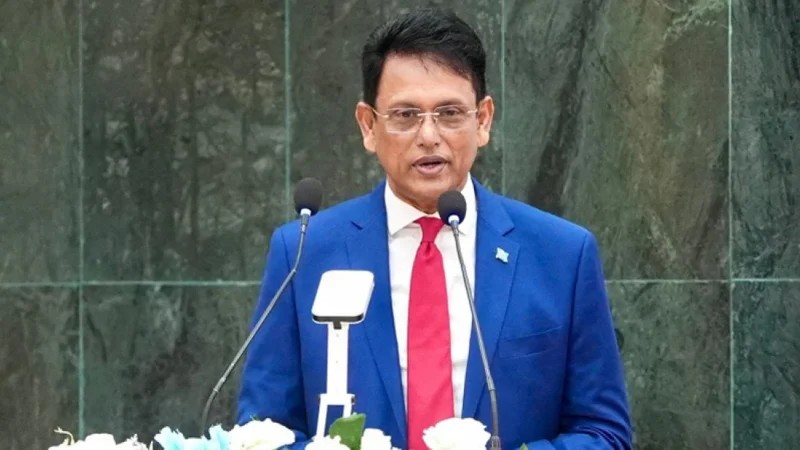
Education and Primary and Mass Education Minister Dr ANM Ehsanul Hoque Milon has warned that individuals involved in supplying substandard textbooks will face exemplary punishment.
He made the remarks as the chief guest at a programme titled “People’s Thoughts on Kachua’s Development”, which was organised by the Kachua Upazila Samity in Dhaka on Saturday.
Milon stated that there would be no compromise regarding textbook quality. He added that any substandard books identified so far had been rejected and destroyed.
“Those involved in supplying substandard books will face exemplary punishment,” he said.
The minister stated that no concessions would be made regarding the quality of textbook printing, specifically concerning the paper, ink, or printing presses used.
He stated that Prime Minister Tarique Rahman wanted to develop the country’s domestic printing industry. As part of that effort, he added, no foreign company had been given textbook printing contracts this year.
Milon expressed hope that quality textbooks would continue to be printed and supplied on time, as had been done in previous years.
The minister said a midday meal programme is currently being implemented in primary schools in 150 upazilas and would eventually be expanded across the country.
The government also plans to introduce a coupon system under the programme, enabling students to buy meals at school canteens using coupons, he said.
New food items will be added to the menu and food supply will be decentralised to boost local economies and encourage local entrepreneurs, Milon said. The initiative will initially be piloted in several districts before being rolled out nationwide.
Milon said sports and cultural studies books would be introduced in Class IV, while a new curriculum is being prepared with greater emphasis on technical education.
“There is no alternative to developing skilled human resources in the changing global landscape,” he said.
The government plans to establish technical schools and colleges in every upazila, he said, adding that a third language would also be introduced at these institutions.
Technical schools and colleges would also be established in Saudi Arabia, he added.
The minister said that question papers for future examinations would be prepared separately at the Bangladesh Government Press (BG Press) and the Army Security Printing Press.
Examinations would be held on schedule to prevent students from losing valuable time due to delays, while efforts would also be made to avoid disruptions caused by monsoon-related disasters, he said.
Regarding the re-evaluation of examination scripts, Milon said the process had been revised based on practical considerations.
The government is also working to introduce a “cross-border education system” to establish Bangladesh as an “education hub,” he said. Milon said the university law would be amended to allow foreign educational institutions ranked among the world’s top 500 to open branches in Bangladesh, subject to approval.
He urged people in Kachua to give the highest priority to education for the area’s overall development.
“There is no alternative to technical and production-oriented education to develop a skilled workforce,” he said, adding that greater emphasis had been placed on technical education to help Kachua’s students become skilled human resources.
Why it matters
The strict enforcement of textbook quality and curriculum reforms directly impacts national educational standards and human resource development in Bangladesh.