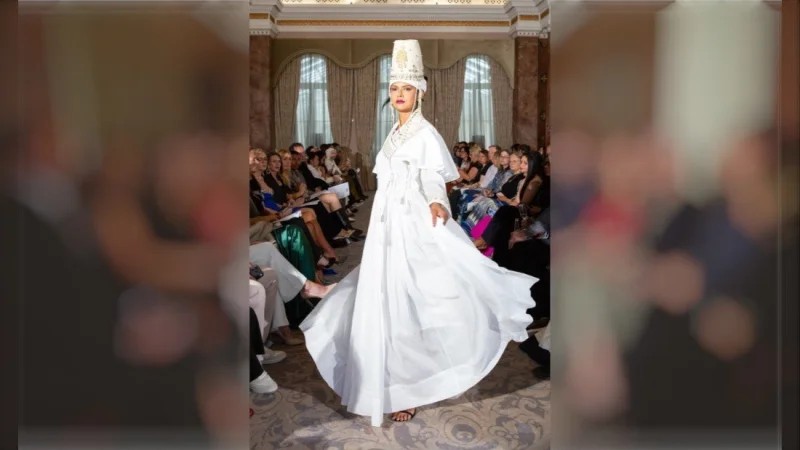
Renowned fashion designer Maheen Khan spoke to the Dhaka Tribune regarding her recent experience at London Fashion Week SS27, where she showcased designs featuring Dhaka’s cherished Muslin alongside Sufi and Sultanate motifs.
This year my presence at the London Fashion Week SS2027 was definitely more impactful than the previous year.
The six-month project involved research focused on incorporating three distinct facets for design development: historical context, heritage textiles, and authenticity of styles.
My collection was inspired by the Bengal Sultanate, followed by Mughal Bengal, which was a period of great transformation regionally.
This collection celebrates our Islamic heritage and the styles of the aristocracy.
In the popular Sufi philosophy of the medieval era, unadorned white cotton was upheld as a fabric symbolizing humility, spiritual purity, and egalitarianism, which subtly tempered the otherwise opulent displays of royal authority.
The elite and rulers of the Bengal Sultanate from 1342 to 1376 blended Persian Islamic court attire with indigenous lightweight textiles, reflecting both political prestige and the pious, simple aesthetic favored in Sufi traditions based on our cultural ancestry.
In Sufism, the outward aesthetic is deeply tied to inward spiritual states, where minimalism serves as a tool for purifying the soul.
Maheen Khan’s designs are being showcased at London Fashion Week SS27, according to a photo from the Dhaka Tribune.
Consequently, the styles were chosen mostly in traditional period cuts as documented in museum archives, while a few were blended with a more contemporary line of attire.
My key and fundamental style ideas displayed wearability and comfort.
The presentation is inspired by Mul Mul Khaas, known as the "Legendary Dhaka Muslin," which possesses very profound historical significance.
"It is not possible to produce the finest quality muslin and make it viable for a niche audience," stated the speaker, who added, "I have used 200 count hand spun hand-woven material."
A superb and wearable handloom has been developed in the same way as the earliest cotton muslin, while being more affordable and viable for both local and international markets.
The ancient process of making Dhaka muslin was rooted in a complex 16-step method rather than literal magic, although its unbelievable lightness and transparency inspired legendary myths.
Spun by highly skilled artisans often working near humid river conditions or on boats, these fabrics achieve thread counts of over 1,000.
Today, through government initiatives, Dhaka muslin is being revived experimentally in small quantities. Although the cost incurred is high, it marks the beginning of a great textile journey.
In the same light, this collection aims to advocate for high-end sustainable fashion that is slow and valued for being made in Bangladesh.
The traditional Mul Mul Khaas is being revived today through training and skill development. The local design industry is campaigning for better results to protect the textile craft.
This highly skilled and advanced handmade weave reached its absolute zenith during the Mughal era, when Emperors and the gentries of courts like Lucknow and Delhi favored it because it allowed complex undergarments to shine through while keeping the wearer cool in the intense subcontinental heat.
This special and wonderful quality is appreciated by buyers even today something that can be nurtured for the intense heat anywhere especially in the western hemisphere.
Dhaka muslin is no longer an endangered craft, and steps are gradually being engineered to carry out slow production responsibly.
With more exposure to international platforms and sustainable shows we hope to find avenues for handloom and conscious fashion in flourishing global markets.
Why it matters
The international showcase of Dhaka Muslin helps promote sustainable Bangladeshi handloom heritage and expands market access for traditional local textiles.