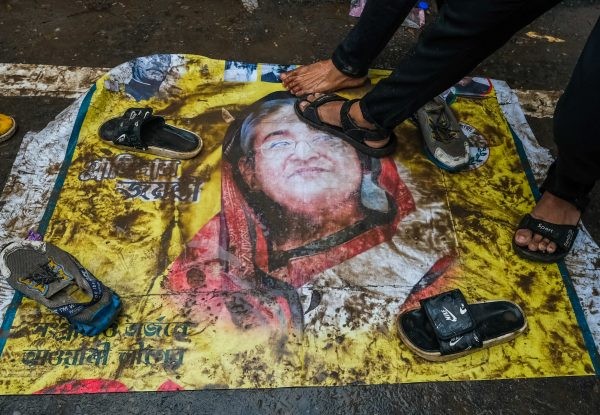
The mass street uprising that toppled Bangladesh’s long‑serving prime minister Sheikh Hasina in August 2024 did more than merely reset the nation’s politics.
It completely broke the security architecture of eastern South Asia.
For fifteen years, India’s foreign policy toward its immediate neighbourhood has been guided by a single, steadfast principle: maintaining the stability of Prime Minister Sheikh Hasina ensures security along India’s eastern border.
Today, that strategy has brought about a major crisis.
Sheikh Hasina is residing in exile on Indian soil, while the newly elected administration headed by Prime Minister Tarique Rahman and the Bangladesh Nationalist Party (BNP) governs Dhaka.
A Bangladeshi court has convicted Hasina in absentia of crimes against humanity and sentenced her to death. The ruling has prompted the government in Dhaka to issue an official request for her extradition.
The circumstances present a complex challenge for New Delhi, described as the “Hasina dilemma,” a problem that cannot be resolved simply by siding with one party.
Instead, it functions as a masterclass in how personal diplomacy can ensnare a major power, leaving India with difficult arguments to balance as it navigates the regional crisis.
India’s dilemma is rooted in a fundamental rule of global statecraft: credibility.
For more than ten years, Prime Minister Sheikh Hasina has jeopardised her own domestic standing in order to meet India’s core national‑security requirements.
Her government intensified its crackdown on anti‑India insurgent groups that had previously taken refuge in Bangladesh, detaining their leaders and transferring them to New Delhi.
She opened crucial transit routes that permit Indian cargo ships and trucks to pass through Bangladesh on their way to India’s land‑locked northeastern states.
If India concedes to Dhaka’s demands and extradites Hasina to face a death sentence, it sends a dangerous signal to other neighbors such as Bhutan, Nepal, and Sri Lanka that India will abandon its closest partners if the political winds change.
However, keeping Hasina protected inside India comes at an equally high cost.
It provides permanent fuel for anti-India sentiment within Bangladesh’s civil society.
The longer India acts as her shield, the easier it is for the BNP government to label New Delhi as an enemy of Bangladesh’s democracy.
This anger puts India’s vital trade links and transit corridors at immediate risk of being shut down by a hostile public.
The strain on the relationship is no longer just quiet, back-channel friction; it has broken out into visible diplomatic boycotts.
Rahman’s recent decision to skip the high-profile BRICS Summit hosted by India in New Delhi served as a clear example of this shift.
Dhaka viewed the invitation to the summit—extended to Rahman as the chair of a regional group, BIMSTEC, rather than as a direct, standalone invite to the premier—as a deliberate diplomatic snub by India.
In retaliation, Rahman refused to travel to New Delhi altogether.
Instead, Rahman deliberately focused his diplomatic efforts elsewhere: a high-profile trip to the United Nations General Assembly (UNGA), where he held a sideline meeting with the Pakistani leadership.
At the same time, Rahman’s administration deepened talks with Beijing over major infrastructure loans.
By refusing a standalone visit to New Delhi, Rahman is sending a clear message: the days of Bangladesh automatically aligning with India’s foreign policy goals are over.
Dhaka is demonstrating that it is fully willing to use its strategic geography to balance India’s influence, utilizing closer ties with Islamabad and Beijing as leverage to show that Bangladesh is no longer dependent on New Delhi's approval.
The Hasina Dilemma serves as a systemic warning to foreign policy planners worldwide: never mistake a single political leader for an entire country.
For 15 years, India’s Ministry of External Affairs operated under the assumption that keeping Hasina happy was equivalent to keeping Bangladesh stable.
New Delhi looked the other way during consecutive, highly controversial Bangladeshi elections, prioritizing immediate border security over the growing domestic anger building up against her regime.
By tying its national interests so tightly to one person, India failed to build deep institutional relationships with Bangladesh’s opposition parties, its student movements, and its wider civil society.
Now that Hasina has fallen, India faces a significant penalty for this policy.
The new leadership in Dhaka views almost every regular, technical bilateral issue—ranging from routine border management to daily electricity grid sharing—through a lens of deep suspicion.
India failed to engage with the broader political spectrum when it had the opportunity. As a result, it now must build diplomatic capital from scratch with a suspicious administration, while also managing the political liability of hosting the former leader.
The relationship between India and Bangladesh cannot remain frozen in this defensive stance forever.
Bangladesh relies heavily on India for daily essential food imports, medical tourism, and electricity.
Conversely, India requires a cooperative Dhaka to ensure its northeastern states do not become cut off or vulnerable to security threats.
Signs of a realistic compromise are slowly beginning to show.
Recognizing the danger of a complete breakdown in relations, India’s diplomats have adopted a quiet, disciplined approach, consistently stating their desire for a “constructive and forward-looking relations” with the new government.
This back-channel diplomacy has successfully defused the initial freeze, setting up an official state visit for Rahman to New Delhi in late November or early December 2026.
To ensure the forthcoming visit succeeds and to move beyond the crisis, the two nations must cooperate on a silent, two‑part strategy.
First, find a third country willing to provide permanent asylum to Sheikh Hasina.
India must quietly work to relocate Hasina to a secure country outside South Asia, such as in the Middle East or parts of Europe.
This move would allow Dhaka to claim a political victory to its domestic voters while sparing India the immense loss of face that would come from direct extradition.
Second, India and Bangladesh must shift to transactional institutionalism.
Both capitals must agree to treat critical issues – like the upcoming December 2026 Ganga Water Sharing Treaty deadline – as technical, non-negotiable economic necessities rather than emotional political weapons.
The Hasina Dilemma proves that in modern geopolitics, yesterday’s absolute stability can easily become tomorrow’s greatest strategic trap.
Bangladesh-India relations will likely never return to the close, personal alliance of the past decade.
The relationship has permanently shifted into a cooler, more transactional reality.
Even so, if New Delhi and Dhaka can successfully separate their internal political speeches from their shared geographic realities, they can prevent a single deposed leader from turning a temporary diplomatic crisis into a long‑term regional disaster.
Why it matters
The resolution of the diplomatic impasse between New Delhi and Dhaka will determine regional security, trade stability, and cross-border transit corridors across eastern South Asia.