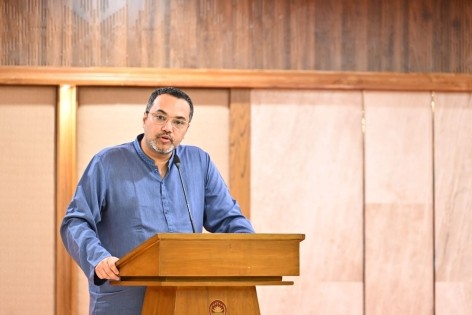
DHAKA, Sept 16, 2026 (BSS) — Prime Minister’s Office spokesperson Mahdi Amin stated today that the country's gas supply had increased significantly following directives from Prime Minister Tarique Rahman, and expressed optimism that this positive trend would persist in the days ahead.
He also highlighted a wide range of measures taken by the government during its seven months in office, covering energy security, economic recovery, public welfare, education, health, infrastructure, digital services, employment, governance, and foreign relations.
Mahdi Amin stated that Prime Minister Tarique Rahman recently promised during meetings with business figures and the media that the gas crisis would be resolved and the situation restored to normal as quickly as possible.
“And implementation of the PM’s commitment started from yesterday within a very short time and the government has taken initiative to make the industries operational again and take forward the economy,” he said.
Regarding the economy, he stated that Moody's recently revised Bangladesh's sovereign outlook from negative to stable, while the nation's B2 sovereign rating remained unchanged.
“This means Bangladesh is now a stable country for investment," he said. "We believe this will not only help increase foreign investment in Bangladesh and enhance the country’s international standing, but also create a positive momentum in trade, investment and employment, particularly in creating the jobs needed to empower women and youth.”
Highlighting the government’s achievements over its first seven months in office, Mahdi Amin stated that the actions and initiatives implemented under the Prime Minister’s strong leadership demonstrate the administration's commitment to ensuring genuine public welfare through specific action plans and accountability.
Every step reflects the government’s patriotism and commitment to public welfare, he said, citing successes ranging from addressing foreign debt pressure and carrying out essential administrative reforms to ensuring corruption-free public services, improving the education and health sectors, and strengthening Bangladesh’s position in the diplomatic arena.
A spokesperson for the PMO stated, "We are rebuilding Bangladesh anew from the ruins of 16 years of fascist rule. It may be difficult to solve all problems completely within just seven months. However, the utmost sincerity and goodwill of the present elected and accountable government, whose sole source of power is the people, are visible in every step."
Mahdi stated that inflation was trending in a positive direction compared to the corresponding period of the previous year, according to data from the Bangladesh Bureau of Statistics.
"Relatively, inflation rate has come down. Food prices have also declined. At the same time, the supply of essential food items is comparatively better than previous years," he said.
Regarding fuel prices, Mahdi stated that, compared to other nations globally and particularly neighboring countries, the price of diesel in Bangladesh is relatively low. He explained that this is because the government is providing the highest possible subsidy on fuel to help reduce the burden on the people.
The government has prioritized several key areas, including youth empowerment; education, information technology, and innovation; overall public welfare and the improvement of living standards; women’s advancement, universal welfare, and social protection; environment-friendly energy and climate-resilient industrialization; modern health infrastructure and public health; transport infrastructure and traffic management; and institutional good governance, public diplomacy, and foreign relations.
The spokesperson stated that the government has implemented several measures over the past seven months aimed at enhancing the welfare and living standards of individuals across various segments of society.
"Among them, one of the major measures is the approval of the National Pay Scale, with a minimum basic salary of Tk 20,000 and a maximum of Tk156,000 to provide financial relief to government employees," he said.
In the energy sector, Mahdi said the government is working to increase domestic gas production by drilling 150 new gas wells in the medium term, followed by another 150 wells later. It is also planning additional LNG import capacity, including a third floating storage and regasification unit (FSRU), with the aim to bring it into operation before 2028.
In response to the energy crisis, authorities have approved in principle the import of 18 LNG cargoes via direct procurement from global companies.
To strengthen long‑term energy security and capacity, US$1 billion of international financing has been secured for the expansion of the Eastern Refinery in Chattogram, and construction work has begun, he said.
Why it matters
Improved gas supply addresses critical infrastructure needs and demonstrates effective government management of key energy resources, supporting economic stability and daily life in Bangladesh.