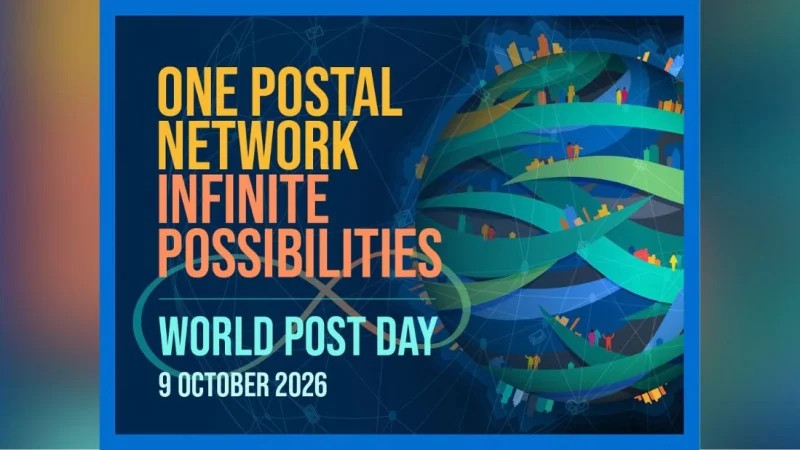
As the world celebrates World Post Day on October 9, many might assume that the relevance of postal services has faded in an era of instantaneous digital messages that travel thousands of miles at the touch of a fingertip.
Thanks to technology-induced transformations and value-added services, today we celebrate a global system that does far more than just deliver mail.
With over 660,000 post offices and 4.6 million staff across the globe, the postal network connects communities and provides essential services designed to leave no one behind.
This year’s theme, “One postal network, infinite possibilities,” reflects the role of the postal system as a trusted facilitator and a one-stop shop enabling people to participate in the economy and society. This includes a young person opening a digital bank account, a family accessing virtual healthcare, a small business reaching global markets, or an elderly neighbor receiving a welfare check.
Crucially, these services are delivered in person, providing a real, human touchpoint in an increasingly digital world. As one of the oldest examples of multilateralism, global cooperation ensures messages and goods arrive even amid disasters, prompting United Nations Secretary-General António Guterres to invite the world to honor postal workers and the Universal Postal Union for all they do to connect our world.
Marking the day, the UN Secretary-General stated: “The postal system is one of the oldest examples of multilateralism in action, with global cooperation ensuring messages, goods and services arrive even amid disasters and emergencies. Today, let’s honour postal workers and the Universal Postal Union – and all they do to connect our world.”
In Bangladesh, the Directorate of Posts is observing a nationwide Postal Service Week starting today, featuring letter festivals, philatelic exhibitions, and postal fairs at educational institutions to engage the younger generation. As the nation joins the global observance of World Post Day 2026, the department is actively transforming its traditional operations into a modern, technology-driven logistics network.
The roots of this system trace back to the 13th century, when Qutb ud-Din Aibak, the Turkic general who founded the Delhi Sultanate, established the first recorded postal network in Bengal using horse messengers from Delhi. The system was further developed by Sultan Muhammad bin Tughluq, as noted by Arabian travel writer Ibn Battuta, when postal officers also engaged in law enforcement.
Further improvements were made under Sher Shah Suri, founder of the Suri Empire, who developed the Grand Trunk Road and established 1,700 postal houses with 3,400 runners. Later, Mughal Emperor Jahangir introduced carrier pigeons to transport messages.
Following the East India Company's takeover of Bengal, Robert Clive established a General Post Office in Kolkata on March 17, 1774, creating a network known as Clive's Post that connected commercial hubs such as Calcutta, Chittagong, Dhaka, Dinajpur, Murshidabad, Rajshahi, Rangpur, and Rajmahal.
On October 1, 1854, the first postage stamps worth one anna and half anna were introduced, followed by the adoption of rail transport that same year and the launch of the Railway Mail Service in 1864. Roadside letter boxes were subsequently introduced between 1856 and 1857.
During the 1971 Liberation War, the provisional government established a postal service comprising 50 field offices near the Indian border in areas controlled by the Mukti Bahini.
Barrister Moudud Ahmed served as the first Postmaster General, while artist Biman Mullick designed the nation's first eight stamps—including one featuring Sheikh Mujibur Rahman—which were later outlawed by the Pakistani government.
Today, that historic framework has expanded into a vast network of more than 8,000 post offices that employ approximately 40,000 staff across Bangladesh. However, the department is currently facing a sharp decline in personal correspondence, with annual mail volumes having plummeted from over 400 million letters in the 1980s and 1990s to less than 50 million today. Consequently, the department must realign its deliverables with tech-driven platforms in order to utilize its full potential.
According to its official site, the Bangladesh Post Office currently provides 16 types of services, which include ordinary and registered mail, Guaranteed Express Post, Express Mail Service, ordinary money orders, Electronic Money Transfer Service, postal cash cards, parcel services, Value Payable Post, Value Payable Letters, postage stamp sales, postal life insurance, savings banks, savings certificate operations, prize bond management, biri banderol printing, and the distribution of non-postal government stamps.
According to a recent ministry press release, the scope of these services is expanding through enhanced e-commerce capabilities, digital tracking, post pickup services, fulfillment centers, specialized transport for agricultural products, and entrepreneur-based franchise post offices.
Recent data shows that approximately 811 tonnes of goods have been transported via Speed Post since March 2026, establishing the service as an affordable lifeline for small enterprises, farmers, and online businesses.
Additionally, international parcel transportation is experiencing growth, with outbound volumes increasing from 243 tonnes in the first three months of the 2025–26 fiscal year to 316 tonnes during the same period in the 2026–27 fiscal year, representing a 29.84 percent rise.
Furthermore, the postal service recently played a vital civic role by ensuring the exercise of voting rights through postal ballots for 1,533,683 expatriate and domestic voters during the 13th parliamentary election in February 2026, proving that this centuries-old institution remains deeply relevant to modern society.
Why it matters
The modernization of the postal network directly enhances national e-commerce logistics, financial inclusion, and secure public service delivery across Bangladesh.