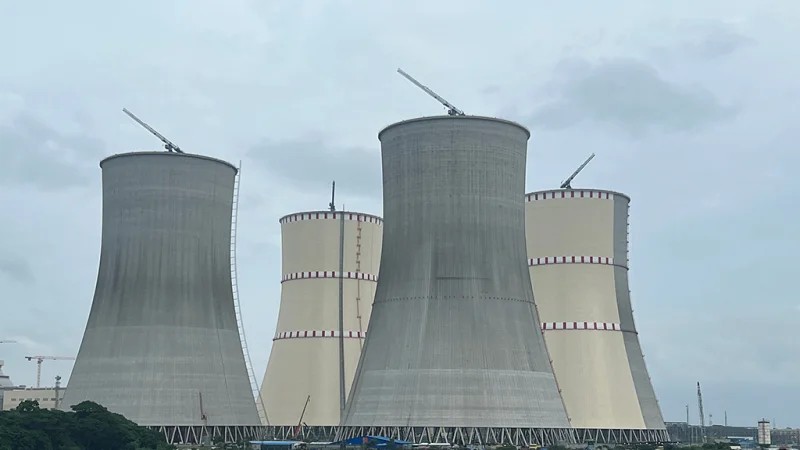
Another consignment of uranium imported from Russia for the second unit of the Rooppur Nuclear Power Plant (RNPP) has reached the project site via an alternative route.
The nuclear fuel was transported to Rooppur in three specially designed trucks via the Dhaka-Mawa Expressway, Padma Bridge, Faridpur, Rajbari and Kushtia.
At approximately 7:30 am on Friday, a convoy transporting uranium arrived at the project site under the supervision of the Bangladesh Army and amid strict security measures enforced by other law enforcement agencies.
Confirming the arrival of the uranium, Rooppur project Site In-charge KBM Ruhul Quddus stated that the nuclear fuel was transported via an alternative route for the first time under tight security.
Quddus explained that this measure was taken to avoid the ongoing garment workers' movement in Gazipur and potential clashes.
The alternative route was used instead of the usual Dhaka-Tangail Highway and Jamuna Bridge, he said.
The convoy travelled from Hazrat Shahjalal International Airport in the capital via the Dhaka-Mawa Expressway, Padma Bridge, Bhanga in Faridpur, Rajbari, Kushtia, and the Lalon Shah Bridge at Pakshi before reaching Rooppur.
With this latest arrival, a total of five uranium consignments have reached the project site, comprising two additional consignments for the first unit of the RNPP and three for the second unit.
Earlier, Russia's state nuclear corporation Rosatom announced plans to transport 163 uranium fuel assemblies for the second unit of Rooppur across seven cargo aircraft, along with another 48 assemblies in two cargo flights to refuel the first unit.
In total, nine consignments of nuclear fuel are scheduled to be brought into the country.
The RNPP is being built with Russian technology, has two VVER-1200 reactor units.
Of the two units, the first unit has already begun activities under the "Power Startup Stage-C" program. On October 29, the Chairman of the Bangladesh Atomic Energy Regulatory Authority (BAERA) granted approval to begin these activities.
During Stage-C, the reactor's capacity will be gradually increased to test the performance of various plant components. According to the plan, the authorities have set a target of connecting approximately 300 megawatts of electricity from the first unit to the national grid on a trial basis in December.
However, this process will be carried out subject to fulfilling the conditions set by the regulatory authority and obtaining the necessary approvals.
Why it matters
The successful delivery of nuclear fuel highlights ongoing international energy collaboration and infrastructure development for Bangladesh's power sector.