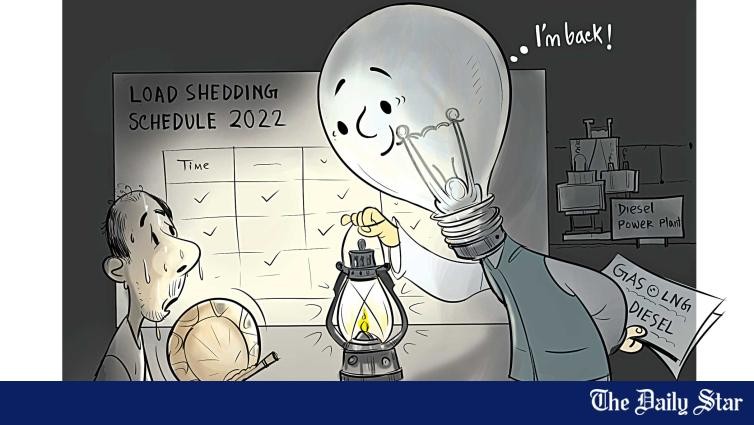
The government's plan for one to two hours of daily power cuts is failing, particularly in the northern region, with indications that the nationwide electricity crisis could worsen in the coming days.
The northern region is already experiencing three to four hours of load shedding daily, with Rangpur bearing the brunt of the impact as the worst-affected area.
The government on Sunday announced a schedule for area-based power cuts to mitigate the electricity crisis.
Experts have warned that as fuel stocks dwindle, the duration of power outages will surely increase in the days ahead. They also pointed fingers at underutilised coal-fired plants and inadequate transmission lines.
As the crisis deepened yesterday, the government introduced new measures to reduce power usage, directing public offices to cut their consumption by 25 percent. Officials have also been instructed to avoid in-person meetings as much as possible in order to further decrease fuel and electricity consumption.
The Bangladesh Power Development Board has been generating 500 megawatts a day more from coal-based plants compared to its production level on June 29, the day load shedding began.
However, the Barapukuria Power Station in Dinajpur has been rapidly consuming its coal stocks without any replenishment. According to sources, coal production at the mine was suspended in late April for underground development work, and the plant will not receive fresh coal until the middle of August.
The plant currently possesses a coal stock sufficient for only 15 days, despite generating merely 200MW out of its total capacity of 525MW.
An official at the Barapukuria coal mine stated that the power plant may be forced to halt generation as a result of a coal shortage.
Data from Nesco, the power distributor for northern districts, shows that it received 500MW yesterday, which is approximately half of the amount it requires.
The demand-supply gap resulted in serious power cuts in the north.
Officials from Dhaka's two electricity distributors, the DPDC and the DESCO, told The Daily Star that they received less power than required and were unable to maintain one to two hours of load shedding in certain areas.
Shamim Hasan, director of public relations for the Bangladesh Power Development Board (BPDB), stated that authorities received certain allegations that distribution companies failed to maintain the schedule, adding that "that was not at a large scale."
The coal-fired 1,320MW Payra Power Plant is currently producing 1,000 to 1,050MW of electricity. However, the facility can only supply power to the Barishal-Khulna region because the transmission line to Dhaka has not yet been completed.
On top of the issues with coal-fired plants, the stock of furnace oil is running low.
An official from the Bangladesh Petroleum Corporation told The Daily Star that the organization has only 1.2 lakh tonnes of furnace oil in stock, compared to a monthly requirement of 55,000 tonnes.
The official said the stock was below the standard practice and the BPC was yet to buy its next consignment of furnace oil.
Bangladesh has a capacity to generate 22,348MW electricity. Of that, around 52 percent is from gas-based plants, 27 percent from furnace oil-based plants, 5.86 percent from diesel-based, 8.03 percent from coal-powered plants, 1 percent from hydro, 0.5 percent from other renewable energies, and 5.27 percent is imported, according to the BPDB data.
The government announced this week that it will shut down ten diesel power plants. The decision follows the government's cessation of LNG imports from the high‑priced spot market last month, after which power cuts began.
LNG injection into the national gas grid has slipped further in recent days, Petrobangla data shows.
Yesterday, it was 430 million cubic feet (mmcfd). On June 29, the injection was 854 mmcfd and in the first week of July, it was 500 mmcfd.
The country is generating 12,000-13,000MW electricity a day against a demand of 14,000-14,500MW.
Talking to The Daily Star, energy expert M Shamsul Alam said, "The schedule [for power cuts] was not made to be maintained automatically. It will be manually implemented and the negligence and ignorance of officials may ruin this process."
He observed that there needs to be more professional efficiency.
State-owned Chittagong Urea Fertiliser Ltd suspended production on Tuesday night due to a gas shortage. Jamuna Fertiliser Company Ltd, the country's largest urea producer, had already shut down earlier for the same reason.
Agriculture Minister Muhammad Abdur Razzaque yesterday said the government was trying to find alternative sources of fertiliser. "We're trying to make both Jamuna Fertiliser Company Ltd and Chittagong Urea Fertiliser Ltd operational. The government has to provide gas to bring these two factories back into operation."
Senior secretaries and secretaries from all ministries and divisions met at the Prime Minister’s Office yesterday to identify measures for cutting expenditure.
The meeting, chaired by Prime Minister's Principal Secretary Ahmad Kaikaus, came up with six decisions and recommendations.
It decided that the Finance Division would issue a circular to cut 20 percent energy sector expenditure.
Officials said they would avoid in‑person meetings and foreign trips as much as possible, while markets would be monitored to keep the prices of essentials at a tolerable level and action would be taken against hoarders.
The National Board of Revenue will take steps at the beginning of the financial year to increase internal resource mobilisation and to achieve the revenue collection target.
The meeting also asked all ministries to review their procurement plans and take initiatives to reduce expenditure.
Talking to reporters afterwards, Kaikaus said, "There's no reason to panic. These are precautionary measures so that we don't have to face any kind of crisis in the future."
Hours after the meeting, the water resources ministry issued an office order asking its officials to avoid personal use of government vehicles and set the thermostats at 26 degrees Celsius at the Pani Bhaban.
Why it matters
The deepening electricity and energy crisis threatens industrial production, agricultural fertilizer supply, and daily economic activity across Bangladesh.